

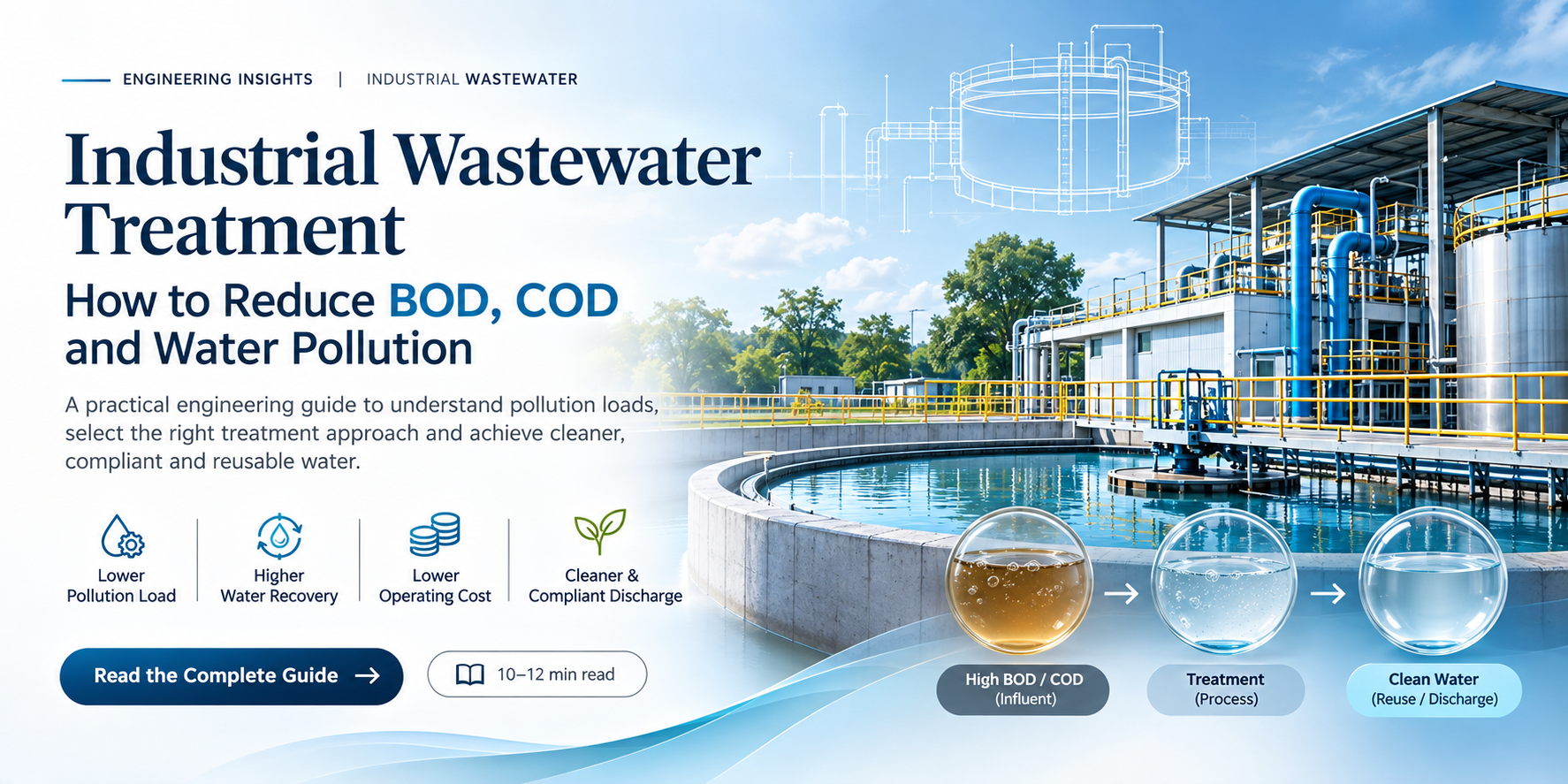
Are you manufacturing effluents with high BOD and COD? Then if such effluents are being disposed of in their raw form, they not only harm the environment but will certainly attract the notice of the pollution board; and not to forget that the wastewater itself is going to be wasted.
The process of treating industrial wastewater (or ETP) entails removal of all impurities, pollutants, suspended solids, oil & grease, and organic matter from the wastewater before discharge or reuse. And the exact method depends upon the type of wastewater being treated, the purpose of treatment and its intended reuse.
What Is Industrial Wastewater Treatment?
Industrial wastewater treatment eliminates contaminants like organic substances, chemicals, oils and suspended solids in the wastewater that comes from industries before it is released or reused.
The composition of industrial wastewater depends on the type of industry and the processes carried out in the particular industry. The technology to be used is selected based on several factors.
What Are BOD and COD in Industrial Wastewater?
BOD (Biochemical Oxygen Demand) is the amount of oxygen that microorganisms require for the decomposition of biodegradable materials. COD (Chemical Oxygen Demand) is the amount of oxygen required for the chemical oxidation of organic and certain inorganic substances. COD is always greater or equal to BOD.
| Point | BOD | COD |
|---|---|---|
| What it measures | Biodegradable organic substances | Organic and certain inorganic substances |
| Method | Oxygen used by microorganisms | Chemical oxidation |
| Time for testing | 3 to 5 days | Several hours |
What is the BOD/COD ratio? When the ratio is around 0.5 or higher, it indicates that the wastewater is responsive to biological treatment. A BOD/COD ratio below 0.3 means the presence of hard-to-degrade compounds which should be treated chemically or by advanced oxidation process. High COD/low BOD ratio is typical for dye and chemical wastewater.
Discharge Limits for BOD, COD and Other Parameters in India
Limits are set by the Central Pollution Control Board (CPCB) and enforced by State Pollution Control Boards such as KSPCB. General standards for discharge into inland surface water are commonly referred to as:
| Parameter | General limit |
|---|---|
| pH | 5.5 to 9.0 |
| BOD (3 days at 27°C) | 30 mg/L |
| COD | 250 mg/L |
| Total suspended solids (TSS) | 100 mg/L |
| Oil and grease | 10 mg/L |
Limits differ by industry and discharge route. Your Consent to Operate sets the limits for your unit, so confirm current values with CPCB or KSPCB. https://kspcb.karnataka.gov.in
Why Untreated Industrial Wastewater Is a Concern
Untreated effluent pollutes rivers, lakes and groundwater, depletes dissolved oxygen and harms aquatic life, and can damage soil. It also creates regulatory risk: a failed discharge sample can lead to notices, penalties or closure directions from the pollution control board.
How to Reduce BOD and COD in Industrial Wastewater
There is no universal technique for all industries. The treatment process will depend on wastewater testing results.
Physical treatment: screening, oil and grease separation, Dissolved Air Flotation (DAF), sedimentation and filtration will get rid of suspended solids and reduce the initial load.
Chemical treatment: use of coagulants, flocculants and pH adjustment helps to eliminate color, very fine particles and some dissolved contaminants.
Biological treatment: micro-organisms help to degrade biodegradable materials, which is the main way to lower the value of BOD. There are many techniques available, including ASP, MBBR, SBR, MBR and anaerobic treatment units.
Advanced and tertiary treatment: Fenton oxidation, ozonation, activated carbon, ultrafiltration (UF) and reverse osmosis (RO) are used to eliminate residual COD, color and TDS. In case almost all wastewater needs to be recycled, a Zero Liquid Discharge (ZLD) unit can be
ETP Process: Step-by-Step
Wastewater testing: Perform tests of BOD, COD, pH, TDS, TSS and oil and grease to determine appropriate technology.
Pretreatment: Screens, grit and oil tanks for removing solid particles and equalization tank to even out flow and load.
Primary treatment: Sedimentation, flotation and chemical addition to lower suspended solids and partial removal of the load.
Secondary treatment: Biological treatment, aerobic or anaerobic, to reduce BOD and COD.
Tertiary treatment: Filtration by sand or carbon, UV disinfection, ultrafiltration or reverse osmosis to achieve necessary purity of water, and dewatering of sludge.
Disposal or reuse: Water after treatment is analyzed according to requirements and either discharged into the environment or reused.
Not sure what kind of treatment you need for your wastewater? Our experts can analyze it and recommend proper ETP design. Get a wastewater test
ETP vs STP vs CETP vs ZLD
ETP: Treats industrial process wastewater containing chemicals, oils and dyes.
STP: Treats domestic sewage from toilets, kitchens and bathrooms.
CETP: A shared plant treating effluent from several units in an industrial cluster.
ZLD: Recovers and reuses nearly all water, leaving no liquid discharge.
ETP Cost: What Decides It
Cost per KLD is non-standard and changes according to the capacity, peak flow rate, BOD/COD/TDS at inlet, technology, application type, civil works, and automation. Operation costs should be taken into account as well, such as power consumption, chemicals, labor, sludge disposal, and AMC.
Mistakes that Companies Must Avoid
Not Testing Wastewater: This results in the trial-and-error process of choosing technology.
Sizing only on average flow: Peak flow and production variations get ignored.
Ignoring pH, load and flow fluctuations: They upset biological treatment.
Focusing only on installation cost: Operating cost decides long-term spend.
Neglecting monitoring and operator training: Problems surface at the pollution board sample.
Overlooking reuse: Treated water can cut freshwater dependence.
Which Industries Need Wastewater Treatment?
Textile, food and beverage, dairy, pharmaceutical, chemical, paper and pulp, and automobile and engineering units all generate effluent that needs treatment. Units in Peenya, Jigani, Bommasandra and Belagavi face their own discharge and water-availability conditions, so local experience matters.
Frequently Asked Questions
1. How can industries reduce BOD and COD in wastewater?
Ans: By using physical, chemical, biological and advanced treatment chosen from wastewater test results. Biological systems such as MBBR, SBR, ASP and MBR mainly reduce BOD, while chemical and advanced oxidation help with hard-to-degrade COD.
2. What is the permissible limit of BOD and COD in India?
Ans: For general discharge into inland surface water, commonly referred limits are BOD 30 mg/L and COD 250 mg/L. Limits vary by industry, so check your Consent to Operate and current CPCB or KSPCB norms.
3. What is the difference between ETP and STP?
Ans: An ETP treats industrial process wastewater, which may contain chemicals, oils and dyes. An STP treats domestic sewage.
4. Can treated industrial wastewater be reused?
Ans: Yes. Properly treated water can be reused for cooling, cleaning, gardening and utilities, depending on final quality and intended use.
5. How can Rudhra Solar & Aqua India Pvt. Ltd. help?
Ans: Through its Deur Water brand, Rudhra provides industrial water and wastewater treatment solutions, including ETP, STP, RO plants and AMC, designed around your wastewater characteristics and reuse goals. Explore solutions at rudhraindustries.com.
Conclusion
Effective treatment begins with understanding the wastewater itself. BOD, COD, pH, TSS and TDS decide the right technology and design, and the right system improves water efficiency and compliance.
Ready to check your wastewater and ETP performance? Request a wastewater assessment or ETP performance audit at rudhraindustries.com or call 99800 00014 to talk to our water treatment engineer.
Industrial Wastewater Treatment · BOD Reduction · COD Reduction · Effluent Treatment Plant · ETP Solutions · Industrial Water Treatment · Wastewater Management · Water Pollution Control · Water Recycling · Zero Liquid Discharge · Water Treatment Plant in Bangalore