

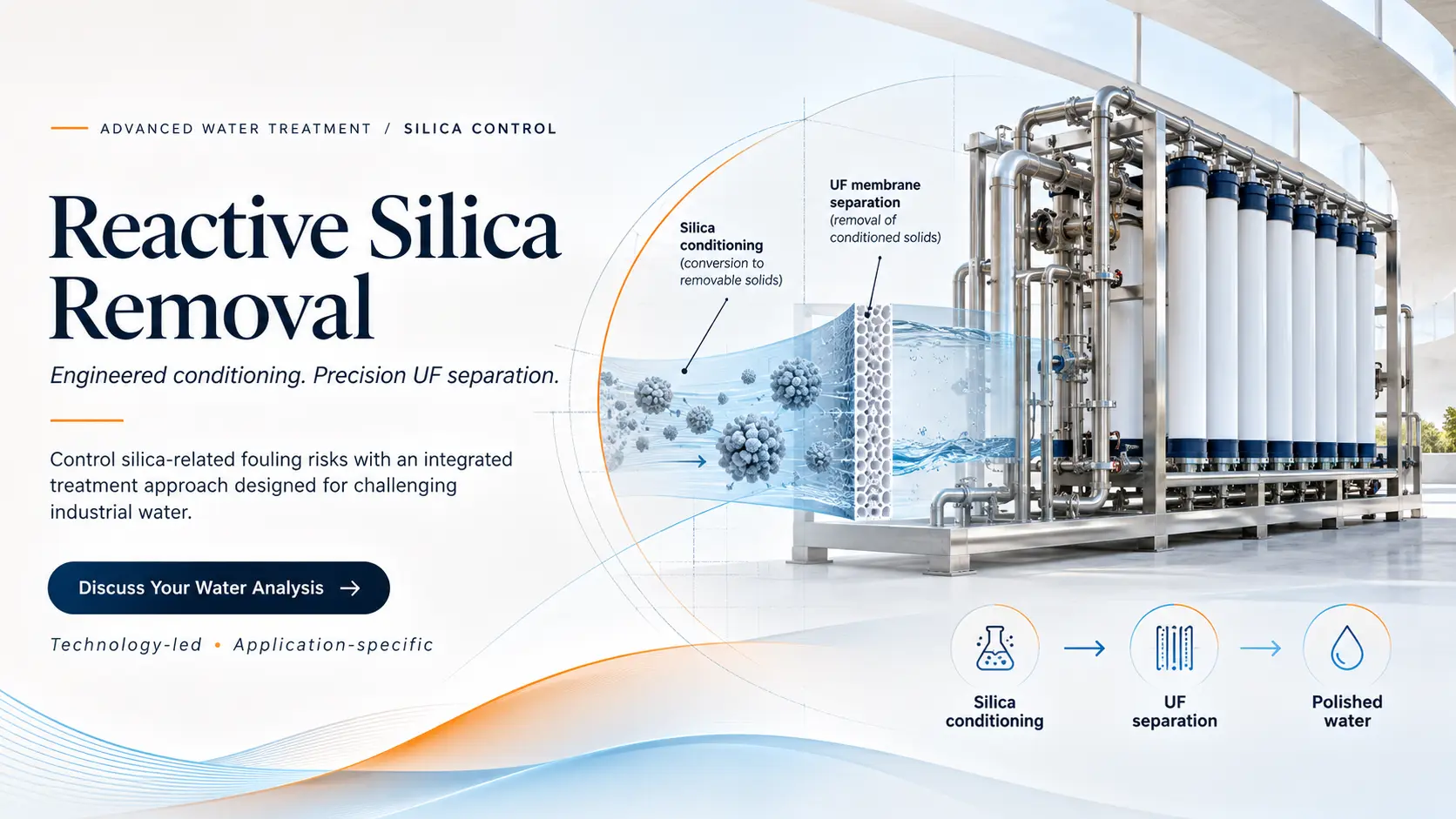
Industrial water treatment involves more than removing visible impurities. Some of the most challenging contaminants remain dissolved in water and can affect equipment performance, treatment efficiency and water quality. Reactive silica is one such concern.
An industrial RO plant may initially operate with stable pressure and satisfactory water quality. Over time, however, permeate flow may decline, water recovery may become difficult to maintain, and membrane cleaning requirements may increase.
One possible contributing factor is silica accumulation within the treatment system.
Unlike suspended particles, dissolved reactive silica cannot be reliably removed through ordinary filtration. As water becomes concentrated during treatment, silica can create scaling risks that affect membrane performance and downstream equipment.
This is particularly important for industries that depend on reliable process water, boiler feedwater, high-purity water and wastewater recycling.
Understanding how reactive silica behaves and selecting an appropriate separation process are essential for effective industrial water management.
This guide explains the differences between silica forms, the challenges associated with silica scaling, available treatment approaches and the role of Deur Water's Special Spiral U Series Side-Stream MBR membrane technology.
Key Takeaways
- Reactive silica exists primarily in dissolved form and requires appropriate separation or removal processes.
- High silica concentrations in RO concentrate can increase scaling risks and restrict achievable water recovery.
- Conventional filtration and ultrafiltration are generally intended for suspended or colloidal matter, not dissolved reactive silica.
- Reverse osmosis, ion exchange, high-pH treatment and other specialised processes have different roles in silica management.
- Deur Water's Special Spiral U Series is designed for reactive silica separation through specialised membrane technology.
- Water analysis and membrane performance evaluation should guide technology selection.
Table of Contents
- What Is Reactive Silica in Industrial Water?
- Reactive Silica vs Colloidal Silica
- Why Is Reactive Silica a Challenge in Industrial Water Treatment?
- Common Industrial Problems Associated with Silica
- How Does Reactive Silica Affect RO Plant Performance?
- Factors Influencing Silica Scaling
- How Quickly Does Silica Concentrate in an RO System?
- Why Conventional Cleaning May Not Be Enough
- How Does Membrane Technology Help in Reactive Silica Separation?
- Reverse Osmosis
- High-pH RO
- Ion Exchange and EDI
- Silica-Specific Antiscalants
- Lime or Magnesium-Based Softening
- Specialised Membrane Separation
- Deur Water Special Spiral U Series Side-Stream MBR Technology
- How the Special Spiral U Series Works
- Typical Specifications
- How It Fits into Industrial Water Treatment
- Potential Industrial Applications
- Industrial Applications of Reactive Silica Management
- How to Select the Right Silica Treatment System
- Why Water Analysis Matters Before Installing a Membrane System
- Membrane Operation, Monitoring and Maintenance
- Frequently Asked Questions
- Conclusion
- References
1. What Is Reactive Silica in Industrial Water?
Silica is a naturally occurring compound found in rocks, soil and groundwater. As water moves through geological formations, it dissolves small amounts of silica and carries them into wells, rivers and other water sources.
In water-treatment applications, dissolved reactive silica is commonly associated with silicic acid, represented as H₄SiO₄.
It is called reactive silica because it reacts with molybdate reagents during standard laboratory testing.
Reactive silica is particularly challenging because it is present in dissolved form. Conventional sand filters and other particle-removal systems cannot reliably separate it from water.
The concentration of dissolved silica varies depending on the geological source, water chemistry, temperature and other environmental conditions.
For industrial facilities using groundwater, monitoring silica is important before designing an RO plant, boiler feedwater system or high-purity water treatment process.
Reactive Silica vs Colloidal Silica: Understanding the Difference
Silica can occur in different forms, and each form requires a suitable treatment approach.
| Form | Characteristics | Common treatment approaches |
|---|---|---|
| Particulate silica | Larger suspended particles | Media filtration and particle separation |
| Colloidal silica | Very fine dispersed silica particles | Coagulation, ultrafiltration and suitable pretreatment |
| Reactive silica | Dissolved silicic acid | RO, suitable ion exchange and validated specialised separation processes |
The distinction is important when selecting treatment equipment.
For example, ultrafiltration can help remove colloidal particles but does not reliably remove dissolved reactive silica on its own.
Similarly, reverse osmosis can reject a substantial proportion of dissolved silica, but the concentration of silica in the reject stream must be considered during system design.
A proper water analysis should distinguish between reactive silica and total silica wherever possible.
2. Why Is Reactive Silica a Challenge in Industrial Water Treatment?
Reactive silica becomes a significant concern when its concentration increases during industrial water treatment.
In an RO system, water passes through a semipermeable membrane, while a portion of the dissolved substances is retained in the concentrate stream.
As more water is recovered, the remaining concentrate becomes richer in rejected constituents, including silica.
If silica concentration exceeds the permissible operating conditions for the particular water chemistry, deposits may form on membrane surfaces and other equipment.
Common Industrial Problems Associated with Silica
RO membrane scaling
Silica accumulation can contribute to membrane fouling, reducing permeate production and increasing cleaning requirements.
Reduced water recovery
High silica concentrations in the concentrate stream may limit the recovery achievable without increasing scaling risk.
Boiler and steam-system deposits
Silica carryover in steam-generating systems can contribute to deposits in turbines and other downstream equipment.
Increased operating costs
Frequent cleaning, membrane replacement, additional pretreatment and water losses can increase overall treatment costs.
Challenges in water recycling
Facilities aiming to reuse treated water need to manage silica alongside other dissolved contaminants to maintain the required water quality.
It is important to remember that these operating symptoms can also result from other contaminants. Water analysis and membrane inspection are necessary to identify the actual cause.
3. How Does Reactive Silica Affect RO Plant Performance?
Reverse osmosis is widely used in industrial water purification because it can reject a broad range of dissolved substances.
However, silica requires particular attention during RO system design.
At normal water pH, a significant proportion of reactive silica remains in a weakly ionised form. Its behaviour changes as pH increases, influencing silica solubility and membrane rejection.
As water recovery increases, silica concentration in the reject stream also increases.
This creates a design challenge: achieving higher water recovery without allowing silica and other scale-forming substances to exceed their acceptable operating limits.
Factors Influencing Silica Scaling
Several factors influence silica scaling potential:
- Reactive and total silica concentration.
- Operating pH.
- Water temperature.
- Calcium and magnesium hardness.
- Iron and aluminium concentrations.
- Total dissolved solids.
- RO recovery and concentrate composition.
According to technical information published by Merck, RO membranes can reject approximately 97–99% of soluble and insoluble silica under suitable operating conditions. However, this does not mean that every RO plant will achieve the same rejection or avoid scaling.
Actual performance depends on membrane specifications, feedwater characteristics and system design.
How Quickly Does Silica Concentrate in an RO System?
Silica concentration in the reject stream rises with recovery. Assuming near-complete rejection, the concentration factor is approximately 1 ÷ (1 – recovery).
| RO recovery | Concentration factor | Feed silica 25 mg/L becomes |
|---|---|---|
| 50% | 2× | 50 mg/L |
| 75% | 4× | 100 mg/L |
| 80% | 5× | 125 mg/L |
The solubility of amorphous silica at 25 °C and near-neutral pH is commonly cited at about 100–120 mg/L as SiO₂, and lower temperatures reduce it further. This means a feed with only 25 mg/L of silica can approach its scaling limit at 75–80% recovery. Membrane manufacturers' projection software should always be used to confirm safe recovery for your specific wat
Why Conventional Cleaning May Not Be Enough
Silica-dominant deposits can be difficult to remove once they become established.
Conventional acid cleaning, which may be effective against certain mineral scales, is not automatically suitable for silica deposits.
Cleaning chemistry must be selected according to the identified foulant and the membrane manufacturer's operating limits.
Preventing excessive silica concentration is therefore an important part of RO system management.
4. How Does Membrane Technology Help in Reactive Silica Separation?
Membrane separation uses selective barriers to separate water from certain dissolved or suspended constituents.
Different membrane technologies operate according to different separation mechanisms.
For reactive silica management, the choice of technology depends on the form of silica, feedwater chemistry, required output quality and intended application.
Reverse Osmosis
Reverse osmosis uses pressure to drive water through a semipermeable membrane.
A substantial proportion of dissolved silica can be rejected, making RO an important component of many industrial water purification systems.
Its performance depends on membrane selection, pH, feedwater quality, pressure and recovery.
High-pH RO
Increasing the operating pH changes the chemical form of dissolved silica and can increase its solubility and rejection under suitable conditions.
High-pH RO configurations may help manage higher silica concentrations in certain industrial applications.
However, hardness and other scale-forming constituents must be controlled carefully before operating at elevated pH.
Ion Exchange and EDI
Suitable anion exchange processes can remove dissolved silica under appropriate conditions.
Electrodeionization (EDI) combines ion-exchange media, selective membranes and an electrical field to produce high-purity water.
EDI is generally installed after suitable pretreatment, often including RO.
For example, DuPont's EDI-310 technical manual specifies dissolved silica of no more than 0.5 ppm in its feedwater specification. This illustrates why the requirements of the selected EDI module must be considered during system design.
Silica-Specific Antiscalants
Specialised antiscalants and dispersants can delay silica polymerisation and allow RO systems to operate at higher concentrate silica levels than untreated systems. Dose and product selection should follow the chemical supplier's projections and the membrane manufacturer's compatibility guidance.
Lime or Magnesium-Based Softening
Warm or cold lime softening, often with magnesium oxide or magnesium salts, can reduce silica through co-precipitation. It is typically used for high-silica, high-hardness water or as pretreatment for high-recovery systems, but it produces sludge that must be handled.
Specialised Membrane Separation
Some industrial applications require membrane configurations designed around specific separation objectives.
Deur Water's Special Spiral U Series Side-Stream MBR is intended for reactive silica separation through specialised membrane technology.
Its suitability should be evaluated against actual feedwater characteristics, required separation performance and operating conditions.
The important point is that membrane selection should be based on verified separation performance rather than assuming that every membrane technology removes dissolved silica in the same way.
5. Deur Water Special Spiral U Series Side-Stream MBR Technology
Industrial facilities increasingly require specialised water-treatment systems that address challenging dissolved contaminants while supporting consistent plant operation.
Deur Water, a brand of Rudhra Industries, offers the Special Spiral U Series Side-Stream MBR membrane technology for reactive silica separation.
This technology is intended for applications where dissolved reactive silica is an important treatment parameter.
Understanding the Side-Stream Membrane Arrangement
In a side-stream membrane configuration, the membrane unit operates separately from the main treatment vessel or process stream.
Water is circulated through the membrane module, where separation takes place according to the membrane's characteristics and operating conditions.
This arrangement allows the membrane separation stage to be incorporated into a wider industrial water-treatment process.
How Special Spiral U Series Fits into Industrial Water Treatment
The Special Spiral U Series can be considered for industrial applications where reactive silica separation is required.
The treatment design should consider:
- Incoming reactive and total silica concentrations.
- Other dissolved and suspended constituents.
- Required treated-water quality.
- Membrane compatibility with the feedwater.
- Operating pressure, pH and temperature.
- Concentrate or reject management.
- Integration with existing treatment equipment.
A detailed technical assessment is necessary to establish the appropriate operating configuration and achievable performance.
Potential Industrial Applications
The technology can be evaluated for applications such as:
Industrial RO pretreatment and integration: Where reactive silica management is required to support the overall water-treatment process.
High-silica groundwater treatment: Where dissolved silica is an important parameter in the incoming water.
Industrial process-water systems: Where water quality requirements depend on controlling dissolved constituents.
Water recycling applications: Where silica separation forms part of a wider treatment and reuse strategy.
The exact suitability of each application must be confirmed through technical evaluation and performance testing.
6. Industrial Applications of Reactive Silica Management
Reactive silica control is important across several industries because water quality directly affects process operations and equipment reliability.
Power Plants and Boiler Systems
Power generation facilities require controlled water quality for steam generation and associated equipment.
Silica carryover can contribute to deposits on turbine blades and other steam-cycle components.
Effective silica management is therefore an important consideration in boiler makeup water and high-purity water treatment.
Pharmaceutical Manufacturing
Pharmaceutical facilities require purified water for various manufacturing and utility applications.
Depending on the required water grade, silica may need to be controlled through multiple purification and polishing stages.
Textile and Dyeing Industries
Textile processing facilities consume water across washing, dyeing and other production operations.
Membrane-based treatment can support wastewater treatment and water reuse, provided the process is designed to address the actual dissolved and suspended contaminants present.
Chemical Manufacturing
Chemical industries may use groundwater, surface water and recycled water in different production processes.
Silica control can be important where dissolved mineral content affects process-water quality or downstream equipment.
Semiconductor and Electronics Manufacturing
Semiconductor manufacturing requires extremely high-purity water for critical production processes.
Silica is one of several dissolved contaminants that must be controlled through an integrated purification system.
RO, ion exchange, EDI and final polishing stages may be combined to achieve the required water quality.
Cooling Tower Systems
Cooling towers concentrate dissolved substances as water evaporates.
If silica concentration becomes excessive, deposits may form on heat-transfer surfaces and other components.
Monitoring silica, controlling cycles of concentration and selecting appropriate treatment methods are important for reliable operation.
7. How to Select the Right Silica Treatment System
There is no single treatment configuration suitable for every industrial water source.
A system designed for low-silica process water may not be suitable for a high-silica groundwater application or a facility with strict high-purity water requirements.
The following considerations should guide technology selection.
Step 1: Conduct a Detailed Water Analysis
Measure reactive silica, total silica, pH, temperature, hardness, alkalinity, iron, aluminium and other relevant parameters.
This helps establish the actual water-treatment challenge.
Step 2: Identify the Required Treated-Water Quality
Determine the silica concentration permitted in the final water based on its intended application.
Boiler feedwater, process water, cooling water and semiconductor applications have different requirements.
Step 3: Evaluate Suitable Treatment Technologies
Compare RO, high-pH RO, ion exchange, EDI and specialised membrane separation options.
The selected process should match the actual separation requirement.
Step 4: Assess Operating Conditions
Consider membrane compatibility, pressure, temperature, pH, recovery and concentrate management.
Step 5: Review Long-Term Operating Requirements
Evaluate cleaning frequency, chemical consumption, membrane replacement, monitoring and maintenance requirements.
A properly designed system should balance water quality, operating reliability and lifecycle cost.
8. Why Water Analysis Matters Before Installing a Membrane System
Selecting a membrane system without understanding incoming water quality can result in inappropriate equipment selection and unexpected operating challenges.
For reactive silica applications, the initial assessment should include:
| Parameter | Why it matters |
|---|---|
| Reactive silica | Helps assess dissolved silica treatment requirements |
| Total silica | Identifies the overall silica content |
| pH | Influences silica speciation and solubility |
| Hardness | Helps evaluate mineral scaling potential |
| Iron and aluminium | Important for assessing potential fouling and deposits |
| TDS and conductivity | Helps understand overall dissolved mineral content |
| Temperature | Influences solubility and membrane operation |
| Turbidity and suspended solids | Helps determine pretreatment requirements |
Based on the results, engineers can assess the treatment requirements and select an appropriate membrane configuration.
For existing facilities, this evaluation can also identify whether the current system can be upgraded or whether additional treatment stages are necessary.
9. Membrane Operation, Monitoring and Maintenance
Even a well-designed membrane system requires appropriate monitoring and maintenance.
Regular performance assessment helps identify changes in feedwater quality, scaling potential and membrane operating conditions.
Important monitoring practices include:
Monitor feedwater quality: Track silica concentration and other parameters that can influence membrane performance.
Review normalised operating data: Monitor permeate flow, pressure drop, salt rejection and recovery to identify changes in system performance.
Control scaling risks: Maintain suitable pretreatment and operating conditions based on membrane projections.
Follow manufacturer cleaning procedures: Select cleaning chemicals and operating conditions according to the actual foulant and membrane specifications.
Maintain treatment records: Document water analysis, cleaning activities and operating performance to support long-term system evaluation.
A proactive maintenance approach helps identify potential problems before they result in significant operating interruptions.
10. Frequently Asked Questions
1. What is reactive silica in industrial water?
Reactive silica is the dissolved form of silica commonly associated with silicic acid. It occurs naturally in groundwater and other water sources and can create scaling challenges when concentrated during industrial water treatment.
2. How do you remove reactive silica from water?
Treatment options include reverse osmosis, suitable ion-exchange processes, high-pH treatment and other specialised separation technologies. The appropriate method depends on silica concentration, water chemistry and required treated-water quality.
3. Can ultrafiltration remove reactive silica?
Conventional ultrafiltration is designed primarily for suspended solids, colloidal matter and other larger particles. It does not reliably remove dissolved reactive silica on its own.
4. What is the difference between reactive silica and colloidal silica?
Reactive silica is predominantly dissolved silicic acid, while colloidal silica consists of fine dispersed particles or polymerised silica. Their different characteristics require different treatment approaches.
5. Why does silica affect RO membrane performance?
As water recovery increases, silica concentration in the reject stream also increases. Under unsuitable chemical and operating conditions, this can contribute to scaling, reduced membrane performance and additional maintenance requirements.
6. Which industries need reactive silica management?
Power generation, pharmaceutical, semiconductor, chemical, textile, manufacturing and cooling-water facilities may require silica management depending on their source-water quality and process requirements.
7. What is Special Spiral U Series Side-Stream MBR technology?
It is a specialised membrane technology offered by Deur Water for reactive silica separation. Its application and performance should be evaluated based on feedwater characteristics, technical specifications and actual operating conditions.
8. Is reverse osmosis alone sufficient for silica removal?
Not always. RO can reject a substantial proportion of silica, but the required final water quality, silica concentration in the reject stream and overall scaling potential may require additional treatment or polishing stages.
9. How can industries reduce silica scaling?
Industries should monitor silica concentration, evaluate water chemistry, optimise recovery, select suitable pretreatment and maintain membrane systems according to manufacturer recommendations.
10. How do I select the right membrane technology for my industry?
Begin with a detailed water analysis, establish the required treated-water quality and evaluate membrane performance under the expected operating conditions. A technical assessment can help identify a suitable treatment configuration.
Conclusion: A Better Approach to Reactive Silica Management
Reactive silica is an important water-quality parameter that can influence membrane performance, water recovery and industrial equipment reliability.
Effective treatment begins with understanding the form of silica present, evaluating the incoming water chemistry and selecting a separation process suited to the required application.
Reverse osmosis, high-pH treatment, ion exchange, EDI and specialised membrane technologies each have a role in industrial water management. Their suitability depends on the actual treatment objective and operating conditions.
Deur Water, a brand of Rudhra Industries, offers industrial water-treatment solutions, including its Special Spiral U Series Side-Stream MBR membrane technology for reactive silica separation.
If your facility is facing silica-related water-treatment challenges or planning an upgrade, a detailed assessment of your feedwater and treatment requirements is the right starting point.
Facing Silica Scaling or Low RO Recovery?
Share your latest water analysis report with our technical team for a free preliminary assessment. We will review your reactive and total silica levels, current recovery and treatment goals, and suggest a suitable configuration.
📞 099800 00014 | ✉️ https://rudhraindustries.com/contact
Request a Water Analysis Review
reactive silica removal · silica removal from water · industrial water treatment · UF membrane technology · ultrafiltration · membrane separation · silica conditioning · colloidal silica · RO membrane protection · silica scaling · membrane fouling control · water reuse · industrial wastewater treatment · boiler feed water · cooling tower water treatment · zero liquid discharge · ZLD · advanced water treatment · water treatment plant · silica control