

Rudhra Industries Team ·
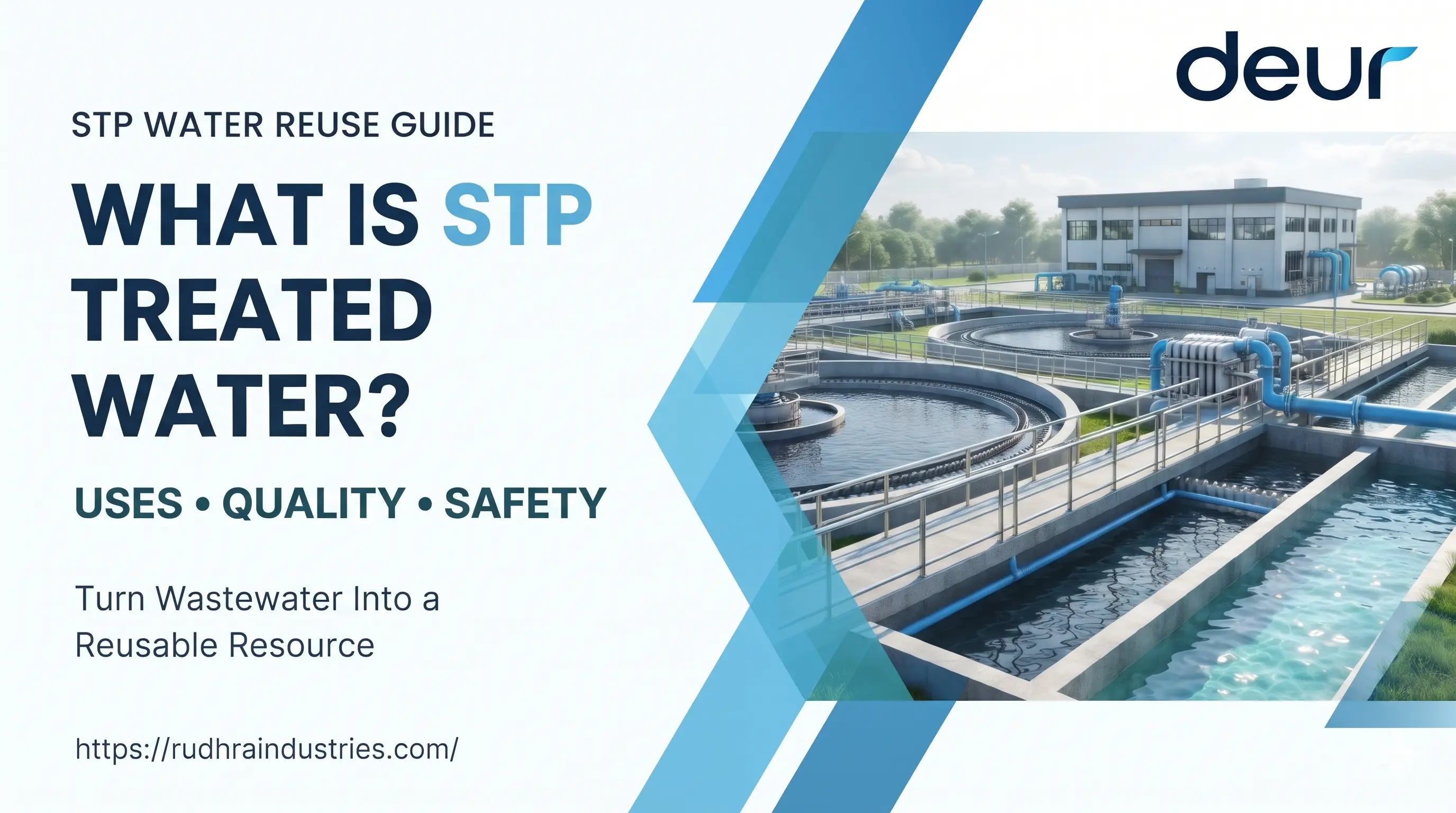
Water is becoming more expensive, and fresh water is becoming harder to find. Apartments, hotels, hospitals and industries need large amounts of water every day. Using fresh water for every purpose can increase water bills and put pressure on available water resources.
STP treated water is a practical solution for reducing fresh water consumption. It can be reused for toilet flushing, gardening, cooling towers, construction and several industrial applications when it is treated to the required quality.
In this guide, we explain what STP treated water is, how it is produced, where it can be used, what quality parameters matter and how to maintain consistent treated water quality.
What Is STP Treated Water?
STP treated water is wastewater that has been processed in a Sewage Treatment Plant (STP) to remove suspended solids, organic waste, impurities and harmful microorganisms.
This wastewater mainly comes from toilets, bathrooms, kitchens and other domestic activities. After treatment, the water can be reused for suitable non-drinking purposes instead of being wasted.
STP treated water is also called:
- Treated sewage water
- Sewage treatment plant water
- Recycled wastewater
- Reclaimed water
Important: STP treated water is not automatically safe for drinking. Its quality must be checked, and it should only be used for applications that match its treatment level and applicable standards.
How Does a Sewage Treatment Plant Work?
A sewage treatment plant cleans wastewater through different treatment stages. The exact process depends on the wastewater quality, plant capacity and required treated water quality.
1. Primary Treatment
In primary treatment, wastewater passes through screens and settling tanks. Large waste materials, sand, oil and some suspended solids are removed.
2. Secondary Treatment
This stage uses biological treatment. Helpful microorganisms break down organic matter present in sewage.
Common technologies include:
- Activated Sludge Process (ASP)
- Moving Bed Biofilm Reactor (MBBR)
- Sequencing Batch Reactor (SBR)
- Membrane Bioreactor (MBR)
3. Tertiary Treatment
Tertiary treatment further improves water quality by removing fine particles and reducing microorganisms.
Depending on the intended reuse, it may include:
- Pressure sand filtration
- Activated carbon filtration
- Ultrafiltration
- Disinfection using chlorine or UV
The treated water is then collected, tested and supplied for suitable reuse applications.
Suggested infographic: Add a simple process diagram showing Screening → Primary Treatment → Biological Treatment → Tertiary Filtration → Disinfection → Treated Water Reuse.
What Are the Uses of STP Treated Water?
Properly treated and tested wastewater can help buildings and industries reduce their dependence on fresh water.
1. Toilet Flushing and Gardening
STP treated water can be used for toilet flushing and landscaping when it meets the required quality standards.
Apartments, residential communities, offices, hotels and commercial buildings can use treated water for these purposes and reduce their fresh water consumption.
2. Cooling Towers and HVAC Systems
Cooling towers require a regular supply of water. Depending on its quality, treated sewage water can be used as cooling tower makeup water.
However, additional treatment or conditioning may be needed to control scaling, corrosion, suspended solids and biological growth.
3. Construction, Washing and Dust Control
Treated water can be used for:
- Construction activities
- Road and floor washing
- Dust suppression
- Vehicle washing, where suitable
- Cleaning selected outdoor areas
The required water quality depends on the application and the possibility of human contact.
4. Industrial Water Reuse
Industries consume large amounts of water for daily operations. Depending on the process requirements, STP treated water can be reused for:
- Equipment and floor washing
- Cooling systems
- Utility applications
- Selected manufacturing processes
- Other non-potable industrial uses
For sensitive industrial applications, additional filtration, RO or other advanced treatment may be required.
Is STP Treated Water Safe for Reuse?
Yes, STP treated water can be safe for approved reuse applications when it is properly treated, tested and maintained.
Safety depends on three important factors:
- The quality of incoming wastewater
- The performance of the sewage treatment plant
- The quality requirements of the intended reuse application
Water suitable for gardening may not be suitable for cooling towers or a manufacturing process. Similarly, water intended for applications involving greater human contact requires stricter quality control.
STP Treated Water Quality Parameters Explained Simply
Water quality testing helps confirm whether an STP is performing properly and whether its treated water is suitable for reuse.
| Parameter | What it tells us |
|---|---|
| pH | Whether the water is acidic, neutral or alkaline |
| BOD | Amount of biodegradable organic matter |
| COD | Amount of chemically oxidisable pollutants |
| TSS | Amount of suspended particles in water |
| Fecal coliform | Indicates possible contamination by microorganisms |
| Turbidity | How clear or cloudy the water is |
| Residual chlorine | Helps check disinfection where chlorination is used |
What Quality Standards Should an STP Follow?
There is no single water quality table that applies to every reuse application.
CPCB and environmental discharge standards specify different requirements depending on the plant, location, discharge conditions and applicable regulations. Separate reuse requirements may apply to toilet flushing, gardening, cooling towers and industrial applications.
Always confirm the applicable CPCB, KSPCB, consent conditions and reuse standards before deciding whether treated water is suitable for a particular purpose.
For technical reference, consult:
- Central Pollution Control Board (CPCB)
- Ministry of Housing and Urban Affairs (MoHUA)
- NITI Aayog
Why BOD, COD, TSS and Disinfection Matter
High BOD
High Biological Oxygen Demand (BOD) indicates that the water contains more biodegradable organic matter than expected. It may cause unpleasant smells and indicate poor biological treatment.
High COD
High Chemical Oxygen Demand (COD) can indicate the presence of excess organic or other oxidisable pollutants. It may affect the suitability of water for reuse.
High TSS
Total Suspended Solids (TSS) are particles present in water. High TSS can make water cloudy and contribute to clogging, deposits and maintenance problems.
Poor Disinfection
Without proper disinfection, treated water may contain microorganisms that create health risks, particularly where people may come into contact with the water.
Regular testing and proper operation help identify these problems before they affect reuse.
How Much STP Treated Water Can a Building Reuse Every Day?
The amount of treated water available depends on the wastewater generated, STP capacity, treatment efficiency and actual water demand.
For example, a residential apartment that generates 100,000 litres of wastewater per day may have a significant opportunity to reuse treated water for flushing, gardening and other suitable applications.
The actual reusable quantity must be calculated after considering:
- Daily wastewater generation
- STP treatment and recovery
- Water quality requirements
- Storage tank capacity
- Daily demand for flushing, landscaping and utilities
- Seasonal changes in water consumption
A proper water balance helps determine how much fresh water a building can replace with treated water.
Common STP Treated Water Problems and Solutions
| Problem | Possible reason | What can help |
|---|---|---|
| Bad smell | Poor aeration, septic conditions or excess organic load | Check aeration, biological treatment and sludge management |
| Cloudy water | High suspended solids or poor settling | Check clarifier, filtration and treatment performance |
| Excessive foam | Detergents, surfactants or process imbalance | Identify the source and adjust treatment |
| High BOD or COD | Excess organic load or poor biological treatment | Review process operation and treatment capacity |
| Poor microbial quality | Inadequate disinfection | Check disinfection system and contact time |
| Frequent filter blockage | High solids or inadequate pretreatment | Inspect filtration and upstream treatment |
The correct solution depends on identifying the actual cause. Simply adding chemicals or increasing disinfection may not solve an underlying treatment problem.
How to Maintain Consistent STP Treated Water Quality
Maintaining good treated water quality requires more than installing an STP. The plant must be operated and maintained correctly.
1. Choose the Right STP Design
The plant should be designed according to wastewater characteristics, daily flow, peak load and required treated water quality.
2. Include Suitable Tertiary Treatment
Additional filtration and disinfection may be necessary to meet reuse requirements.
3. Conduct Regular Water Quality Testing
Test treated water at an appropriate frequency for the intended application. Maintain records and investigate any unexpected changes.
4. Follow Scheduled STP Maintenance
Regular maintenance should include:
- Blower and aeration system inspection
- Pumps and electrical equipment checks
- Filter maintenance
- Sludge removal and management
- Disinfection system monitoring
- Biological process monitoring
5. Choose Professional STP AMC Services
Annual Maintenance Contract (AMC) services help maintain treatment performance, reduce unexpected breakdowns and support consistent water quality.
STP Treated Water vs Fresh Water
| Feature | Fresh Water | STP Treated Water |
|---|---|---|
| Main source | Borewell, municipal supply or other freshwater sources | Treated domestic wastewater |
| Typical use | Drinking, cooking and general applications | Approved non-potable applications |
| Treatment requirement | Depends on source and intended use | Must meet required reuse quality |
| Cost consideration | May involve higher freshwater consumption costs | Can reduce freshwater demand and associated costs |
| Sustainability | Depends on source availability | Supports water recycling and resource conservation |
STP treated water does not replace fresh water for every purpose. Instead, it helps use fresh water more efficiently by supplying suitable recycled water for non-potable needs.
Frequently Asked Questions About STP Treated Water
1. Can STP treated water be reused?
Yes. Properly treated and tested STP water can be reused for toilet flushing, gardening, cooling towers, construction and selected industrial applications, depending on the required quality.
2. Is STP treated water safe for gardening?
It can be used for landscaping and gardening when it meets the applicable water quality requirements. The quality should be checked regularly, especially where people may come into contact with the water.
3. Can STP treated water be used in cooling towers?
Yes, in many cases. However, cooling tower reuse may require additional treatment to control scaling, corrosion, suspended solids and biological growth.
4. Does STP treated water have a smell?
Properly treated water should not have a strong unpleasant smell. Bad odour may indicate treatment or operational problems that need investigation.
5. How often should STP treated water be tested?
Testing frequency depends on plant capacity, reuse purpose, consent conditions and regulatory requirements. Regular monitoring is important to maintain consistent quality.
6. What happens if STP treated water fails quality tests?
The water should not be used for an application for which it fails the required standards. The treatment process should be checked, corrective action taken and water retested before reuse.
7. Who can design, install and maintain an STP in Bangalore?
An experienced sewage treatment and wastewater management company can assess wastewater characteristics, determine treatment capacity, design the system, install equipment and provide maintenance support.
STP Installation and Maintenance in Bangalore
Looking for STP installation in Bangalore or reliable STP maintenance services in Bangalore?
Rudhra Solar & Aqua India Private Limited, through its water treatment solutions under Deur Water, provides support for sewage treatment and wastewater management requirements.
Our team can help with:
- STP design and installation
- Sewage treatment plant upgrades
- Tertiary treatment and filtration
- Treated water reuse solutions
- STP operation and maintenance
- STP Annual Maintenance Contract (AMC)
Every project requires a proper assessment of wastewater quality, plant capacity, available space and reuse requirements before selecting a suitable solution.
Explore our Sewage Treatment Plant Solutions or Request a Callback to discuss your requirements.
Conclusion
STP treated water is an important solution for reducing freshwater consumption in apartments, hotels, commercial buildings and industries.
When wastewater is treated correctly and its quality is monitored regularly, it can be reused for many non-potable applications. The key is to select the right treatment system, understand the intended use and maintain consistent water quality.
Planning an STP or looking to improve your existing plant?
Connect with Rudhra Solar & Aqua India Private Limited for professional sewage treatment, treated water reuse and STP maintenance solutions in Bangalore.
Visit Rudhra Industries | Request a Site Consultation
STP Treated Water · Sewage Treatment Plant · STP Water Reuse · STP Plant · Sewage Treatment · Wastewater Treatment